CreARTivity
Magazine
When leaving stops being freedom: a conversation with essayist Huck Smith
In his second essay collection, New Jersey-born essayist Huck Smith asks whether thirty years of walking away was ever freedom, or just the thing he learned to do best. A conversation about The Leaving Gene, chosen family, humor in grief, and telling the truth about yourself first.

In this article
Huck Smith’s second essay collection almost had a different name. For most of its life the manuscript was called Raider at the Door, after his dog, and people kept assuming he had written a thriller. Then he wrote the essay that gave the book its final title, and a phrase he had not planned on turned out to describe thirty years of his adult life.
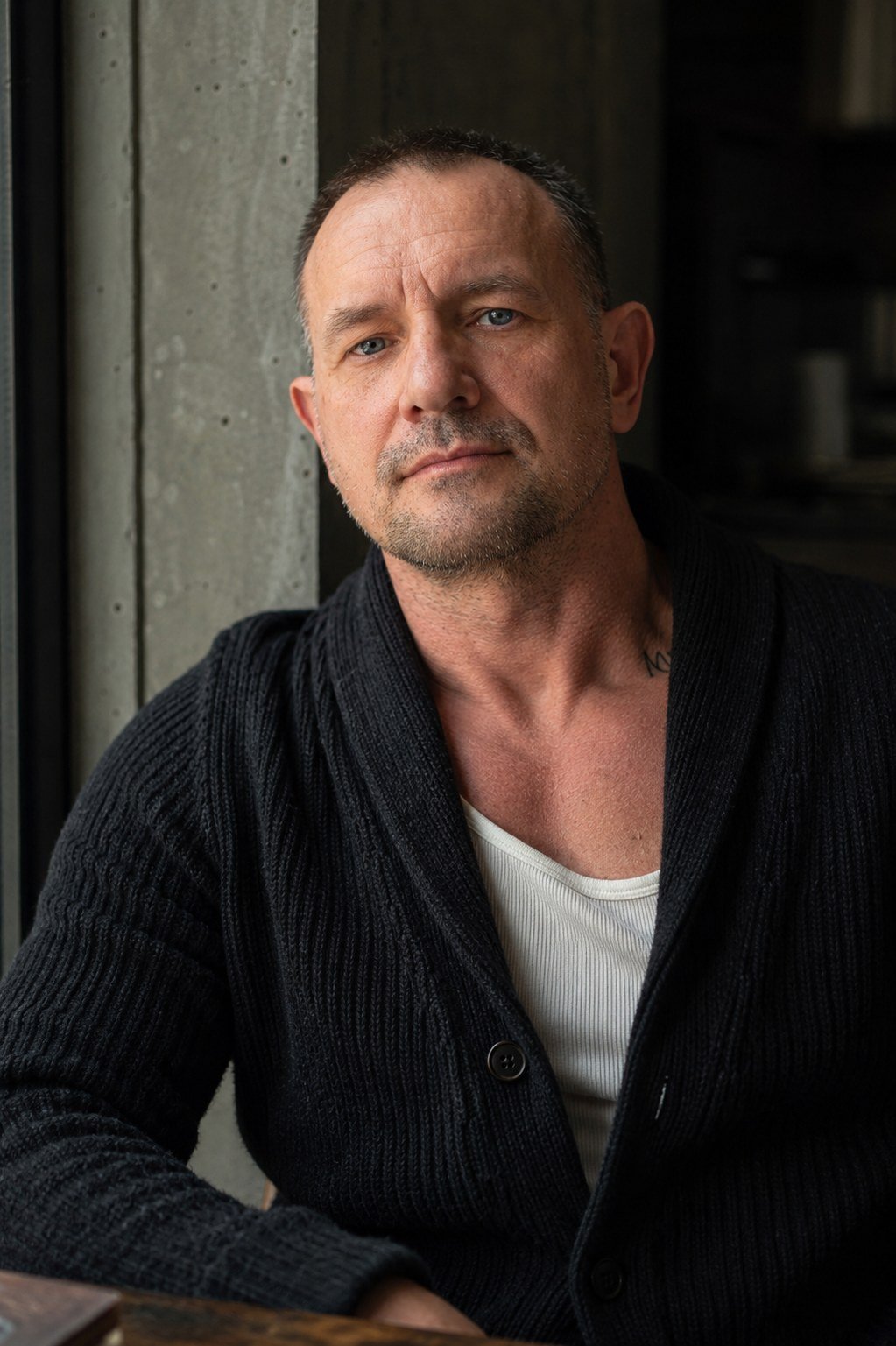
The Leaving Gene: Essays on Staying, Going, and the Cost of Both arrives October 27 from Quick Draw Press. On its cover, a leash lies coiled with nothing attached to it. Inside, Smith, who is 52, goes back through the relationships, homes, and versions of himself he walked away from, and asks a question he avoided for decades: how much of what he called freedom was simply the thing he had learned to do best?
He learned it early. Smith grew up in northwest New Jersey, the rural corner of the state that, as he puts it, most people do not believe exists: horse farms, lakes, long stretches of road. From the outside it looked idyllic. Inside the house it was not, and at thirteen he left. Leaving saved him, he says, and then it became a reflex.
Smith now lives in Dallas, in the Oak Lawn neighborhood, where he says he is finally learning what it feels like to take off armor he has worn most of his life. He writes whenever a thought demands it, at two in the afternoon or two in the morning, usually in reading glasses and gym clothes, with an energy drink at his elbow and a dog lobbying hard for a walk. His first collection, Boys, Bars & Becoming: Essays for the Still Reckless, Still Hopeful, came out earlier this year. A third is already finished.
He answered CreARTivity’s questions in writing. What follows has been edited for length and clarity. Some of his answers touch on suicide and family violence. He discusses them with the same candor, and the same refusal to make himself the hero, that runs through the book.
A title that arrived late
When did the phrase “the leaving gene” arrive, and did it name something you already understood about yourself?
The book was originally called Raider at the Door, which made perfect sense to me because Raider is my dog and that image is central to the book. The problem was, nobody else knew that. People kept hearing the title and assuming I’d written a thriller, which is decidedly not what this book is.
Then I wrote the title essay, “The Leaving Gene,” and it became crystal clear. That phrase named the architecture and the spine of the entire book. I already knew the individual pieces of that essay. They were experiences and ideas I’d carried around separately for years. But seeing them together, married by those words, showed me something I hadn’t completely understood about myself before. The writing usually knows something before I do.
You describe leaving as possibly a habit learned too well rather than freedom. What was the specific moment that made you question it?
I have an incredible ability to know something is true, mentally file it away, and then continue living as though I don’t know it. Writing doesn’t really allow me to do that.
The specific moment came while I was writing “Careful Is Not the Same as Healed.” I started putting these different versions of myself on the page, and there I was, leaving again and again, often with a wake of destruction behind me. Individually, I had made each departure make sense. This relationship wasn’t right. That situation had become untenable. This person hurt me. And maybe all of those things were true.
But as I wrote them down, the pieces started fitting together like Tetris. Suddenly I couldn’t call them one-offs anymore. There was a pattern, and worse, it was now in ink in front of me. That was the moment I had to ask myself a much harder question: How much of what I had been calling freedom was actually just leaving because leaving was the thing I had learned to do best?
The word “gene” suggests inheritance. Who did you inherit it from?
Apparently, I inherited it from both sides. My biological mother and my biological father were two people who, as far as I know, never spoke a single word to each other after my less-than-immaculate conception. So maybe I never stood a chance.
I didn’t learn the full story until I was old enough to go looking for it myself. By then, my mother had died. The man who raised me had died. And when I found my biological father through Ancestry.com, he promptly blocked me, leaving me without the ability to ask even the simplest questions about where I came from.
There’s something almost painfully on-the-nose about discovering that leaving may be part of your inheritance and then having the person you inherited it from respond to your existence by disappearing.
The subtitle promises the cost of both. What has staying cost you?
Staying cost me some of the recklessness I had previously inhabited, and I want to be clear: it was well worth the cost. There was a version of me who could always leave, reinvent, start over, and call that freedom. Staying required me to give up some of that mythology.
But the book also looks at staying through my sister. We grew up in the same house, with the same parents and many of the same circumstances, and somehow developed completely different survival strategies. I left. She stayed. Both choices altered our lives, and neither came without a price.
We tend to romanticize leaving as brave and staying as loyal. Sometimes they are. Sometimes they’re something else entirely. The bill eventually comes due either way.
Did writing the book change the pattern, or just give you better language for it?
I don’t know that it gave me better language for it as much as it gave me a condensed view of it. When you take fragments of thirty years of your adult life and compress them into three hundred pages, patterns become a lot harder to ignore.
In life, these things happen years apart. You can explain each one individually, file it away, and move on. On the page, suddenly they’re twelve pages apart.
Did writing the book change the pattern? I think recognizing it has changed how quickly I act on the impulse. I’m much more interested now in asking myself why I want to leave before deciding that leaving is the answer. I don’t think writing the book magically healed anything, but it made it much harder to pretend I didn’t know what I know.
The New Jersey most people do not believe exists
What kind of New Jersey did you grow up in, and what did it teach you about staying and going?
I grew up in northwest New Jersey, the part of Jersey most people don’t believe exists. Horse farms are plentiful. There are mountains and lakes and long stretches of rural road. It’s a beautiful place, and from the outside, probably an idyllic place to grow up.
But New Jersey also taught me to run.
In my first book, Boys, Bars & Becoming, I write about some of the absurdity and chaos I endured growing up, from my father to my mother’s suicide attempts. At thirteen, things had become so bad that I had formed a plan to end my father’s life. That is an insane position for a thirteen-year-old kid to find himself in.
Ultimately, I realized there was another choice. I could leave. So I did.
I think that decision saved me, but it also taught me something that took decades to question: when things become unbearable, you go. Running worked. And because it worked, it became very easy to keep choosing it long after I was no longer thirteen.
What is the first leaving you remember? Not necessarily yours.
My mother attempting to take her own life in front of my sister and me when I was eight.
It’s a leaving of a different kind because it carries the possibility of permanence. At eight years old, I didn’t have the language or the knowledge to understand what was actually happening. I only understood that something terrifying was happening and that the person who was supposed to be there might suddenly not be.
I think that shaped my relationship with leaving long before I knew I had one. Leaving wasn’t an abstract idea or some grand act of reinvention. It could happen suddenly. I just knew that people could leave, and sometimes they could leave forever.
You are 52. What can you write now that you could not have written at 30?
I don’t think I’ve lost access to anything. If anything, I have more access now because I can finally be honest about it.
At thirty, I was still too close to some of my own disasters. I needed to believe certain versions of those stories because they made my choices easier to live with. I could make myself the hero, or at least the guy who did the best he could under impossible circumstances. At fifty-two, I don’t need to do that anymore.
What age gave me was distance. At thirty, I could have told you what happened. At fifty-two, I can tell you what part of it was mine.
Writing about people who did not ask to be written about
Family estrangement runs through the collection. How do you write honestly about people who did not choose to be in it?
Whenever possible, I share what I’ve written with the people who appear in my work and ask whether they’re comfortable with me using their names. Most are. Some aren’t. In those cases, names get changed, and occasionally small identifying details shift to protect someone’s privacy.
But there’s an important distinction between protecting someone’s privacy and giving someone else ownership over my experience. I’m writing about what happened to me and how I remember it. That doesn’t mean my version is the only version.
I’m not interested in using the page to settle scores. In fact, the only person I’m ever really willing to vilify in my writing is me. If I’m asking readers to look honestly at themselves, I have to be willing to go first.
What did you cut because it was true but not yours to tell?
I can say what a person did. I can’t necessarily say why they did it. It would be dishonest to speculate about what was happening inside someone else simply because it makes an essay more compelling or better serves my narrative.
My job isn’t to solve the other person. It’s to tell the truth about what happened to me after they entered the story.
Addiction and grief sit close together in these essays. Separate subjects, or the same subject from two angles?
I think addiction and grief can absolutely walk hand in hand, but I also think they can exist entirely separately. I would never suggest that every addiction is grief in disguise, or that everyone who grieves is looking for something to numb it. But in my life, there have certainly been places where the two have touched.
Grief creates an absence. Addiction can offer something to put in that space, even temporarily. A person, a substance, sex, attention, chaos, whatever allows you not to sit quietly with what is missing.
I think both also have something to do with leaving. Addiction can be a way of leaving yourself without physically going anywhere. Grief is what remains when someone or something else has left. So no, I don’t think they’re the same subject. But they definitely know each other.
Family, chosen on a Tuesday
Chosen family is a phrase that gets used until it goes soft. What does it mean in your life on an ordinary Tuesday?
First, I love that you said “an ordinary Tuesday,” because I reference Tuesday all the time. It’s the most overlooked day of the week. Monday gets all the hatred, Wednesday gets to be the middle, Thursday has anticipation, Friday has an entire personality. Tuesday gets tacos. That’s it.
And I think chosen family reveals itself on Tuesdays.
For me, blood is just biology. Chosen family is reserved for the very small number of people who actually know me, all of me, including the ugly parts, and stay anyway. I can count those people on one hand, and I know how lucky I am to have them. They’re the people built into the infrastructure of my life. The emergency contacts. The people who don’t require the cleaned-up version of the story before they show up.
Who is the friend the book would not exist without?
Karin, my friend since childhood. Without question. She didn’t know it at the time, and honestly, neither did I, but Karin saved my life on repeat simply by being my friend. She didn’t know everything that was happening inside my house. She wasn’t showing up thinking she was rescuing me. She was just there.
Karin gave me a place where I got to just be a kid. She gave me evidence, very early, that I was worth showing up for. There’s no way to repay someone for that. You just spend the rest of your life being grateful they showed up when they did.
Coming out is its own kind of leaving and arriving. How do you write about it decades on?
Coming out isn’t a one-and-done experience. It happens in layers. It’s not like you hold a press conference, make the announcement, and suddenly everyone you will ever meet for the rest of your life has been notified. You come out over and over again.
What interests me now is what distance has allowed me to see. There were small victories along the way that I couldn’t recognize at the time because I was too close to them. Moments of courage that just felt like survival. Decades later, I can finally look back at that younger version of myself and give him some credit.
What does this book say to a younger queer reader who is about to leave somewhere?
Leaving isn’t always about coming out. It isn’t always about being queer. Sometimes there are much larger monsters in the room.
What I hope a younger queer reader takes from this book is permission to trust their gut. I know “it gets better” has been used so often that it can sound like something we slap on a T-shirt, but it does get better. I mean that where you are right now does not have to be where you remain.
Move. Ask for help. Find the door. You are allowed to leave something that is hurting you, and you don’t need to know exactly where you’re going before you go.
Looking for the convenient liar
Where does the humor come from in an essay about grief, and how do you keep it from becoming a way to dodge?
I don’t view humor as dodging the pain. If anything, I think humor can dismantle some of its power.
The important thing for me is that the joke can’t replace the truth. If I make you laugh and then use that laugh as an exit ramp before I have to say the difficult thing, that’s dodging. The humor has to get us closer to the uncomfortable part, not farther away from it.
And usually, if someone is going to be the punchline, it’s me. Grief and humor aren’t opposites to me. Some of the hardest moments of my life have also been absurd. Sometimes laughing is simply another way of surviving long enough to tell the truth about them.
Walk us through how an essay gets made.
Every essay starts with a single thought. I build around it, and most of the time I have no real idea where I’m going to end up. I just write until there’s nothing left to say. Then I let it sit. Sometimes for a day, sometimes a week, sometimes months. When I come back, I start reorganizing the thoughts, but more importantly, I start looking for all the places where I was a convenient liar.
Self-preservation kicks in when I’m writing. I’ll give myself a noble motivation, a reasonable explanation, a clean exit. Distance lets me see those places on the page and ask: Is that actually what happened, or is that the version that makes me easier to like? Then I rewrite. The honest thing resonates far more than the clean thing.
Where is your line on how much of yourself to reveal, and has it moved between the two books?
I only know where the line is when it’s in front of me and my gut says, Nope. I’m not ready to confess this to the world.
I do think the line has moved between the two books. I’m more comfortable being exposed now, probably because I’ve learned that the things we’re most afraid to admit are often where readers recognize themselves. But honesty is the requirement. If I need to write around something, soften it, or protect myself from it, then that essay isn’t ready. I’d rather keep a great piece in a drawer than publish a safer, less honest version of it.
Same man, different season
Is The Leaving Gene written by the same man who wrote Boys, Bars & Becoming, or by someone the first book made?
Same man, different season. I remain still reckless and still hopeful, and I genuinely hope I never lose either of those things. The books aren’t a linear progression chronologically. There are essays in The Leaving Gene that I wrote back in 2016 and others I wrote only months before I finalized the manuscript.
That’s what I love about essay collections. You can shine a light on one part of yourself without pretending it’s the whole person. So yes, it’s the same man. He’s just looking in a different direction.
What did the first book teach you that you applied to this one?
One of the biggest lessons came from recording the audiobook for Boys, Bars & Becoming myself. There were sentences that looked perfectly fine on the page and felt completely wrong coming out of my mouth. So with The Leaving Gene, I read the manuscript aloud before I finalized it, and I made a lot of edits because of what I heard. The first book didn’t just teach me how to publish the second one. It taught me how to hear it.
You published outside the big houses. What has that made possible, and what would you tell a writer considering it?
With my first book, an editor and publisher told me to remove the essay “Second Line.” They thought it could kill the book. I ultimately decided to do it my own way and keep it, and that essay became the catalyst for going back through the entire manuscript and rewriting every essay deeper.
My advice is to look beyond the advance and ask very specific questions about what happens after you sign. What launch support are they actually providing? Who handles publicity? Having access to 38,000 retail locations does not mean your book will be sitting in 38,000 stores. Know what you’re giving up, know what you’re getting in return, and don’t confuse having a publisher with having a team actively working your book.
Where does the third book go? The instinct, not the pitch.
Well, the third book is actually done. It’s currently with a potential publisher, so we’ll see what happens, but I can share that it’s tentatively titled Reporting Live from Inside the Mess.
I’m not particularly interested in presenting myself as someone who has figured everything out and has now returned from the mountaintop with answers. I’m much more comfortable saying, “Well, this is a mess. I appear to be part of it. Let’s take a look.”
After the last page
What do you hope a reader does with this book once they finish it?
Obviously, I hope they recommend it to every person they’ve ever met, buy twelve copies, and write a glowing review. I’m an author, not a saint. But the response I really love is when someone tells me they had to sit with something for a while.
Keep it. Dog-ear it. Argue with me in the margins. Put it face down for a week because I pissed you off. Then pick it back up. And if one essay makes you think immediately of someone you love, hand them the book and say, “Read this. Then call me.”
We closed with a lightning round. Asked for a bar, anywhere, any year, Smith did not hesitate: The Yacht Club, 1995, “peak experience.” The song that sounds like leaving is Luke Bryan’s “Drink a Beer.” The sentence he keeps stealing from belongs to Alexander Chee, on writing as a ticket to escape into the truth rather than away from it. His advice to his twenty-five-year-old self, which he knows would be ignored: “Be more honest about what you need in a relationship and stop worrying about what someone else will think about it.” As for the questionable decision that never made it into a book, he expects to take it to his grave.
What question should we have asked, and what is your answer to it?
Okay, you’ve spent two books examining your own bullshit. Have you actually learned anything, or are you just getting better at writing about it?
Probably both. I’d love to give you the beautifully evolved answer and say that once you recognize a pattern, you stop repeating it. That has not been my experience. Apparently self-awareness and good decision-making are two entirely different skill sets.
I’ve learned that understanding why I became a certain way doesn’t excuse what I do with it. Childhood can explain the reflex. Grief can explain the armor. Fear can explain why the door looks so appealing. Eventually, though, I’m the adult standing there with my hand on the knob.
I’m still reckless. I still make questionable decisions. I still occasionally recognize my own bullshit several exits after I should have gotten off the highway. The difference is that I’m getting much worse at pretending I don’t see it.
The Leaving Gene arrives October 27. Preorder your copy on Amazon today, and maybe a second one for the friend you thought of while reading this.
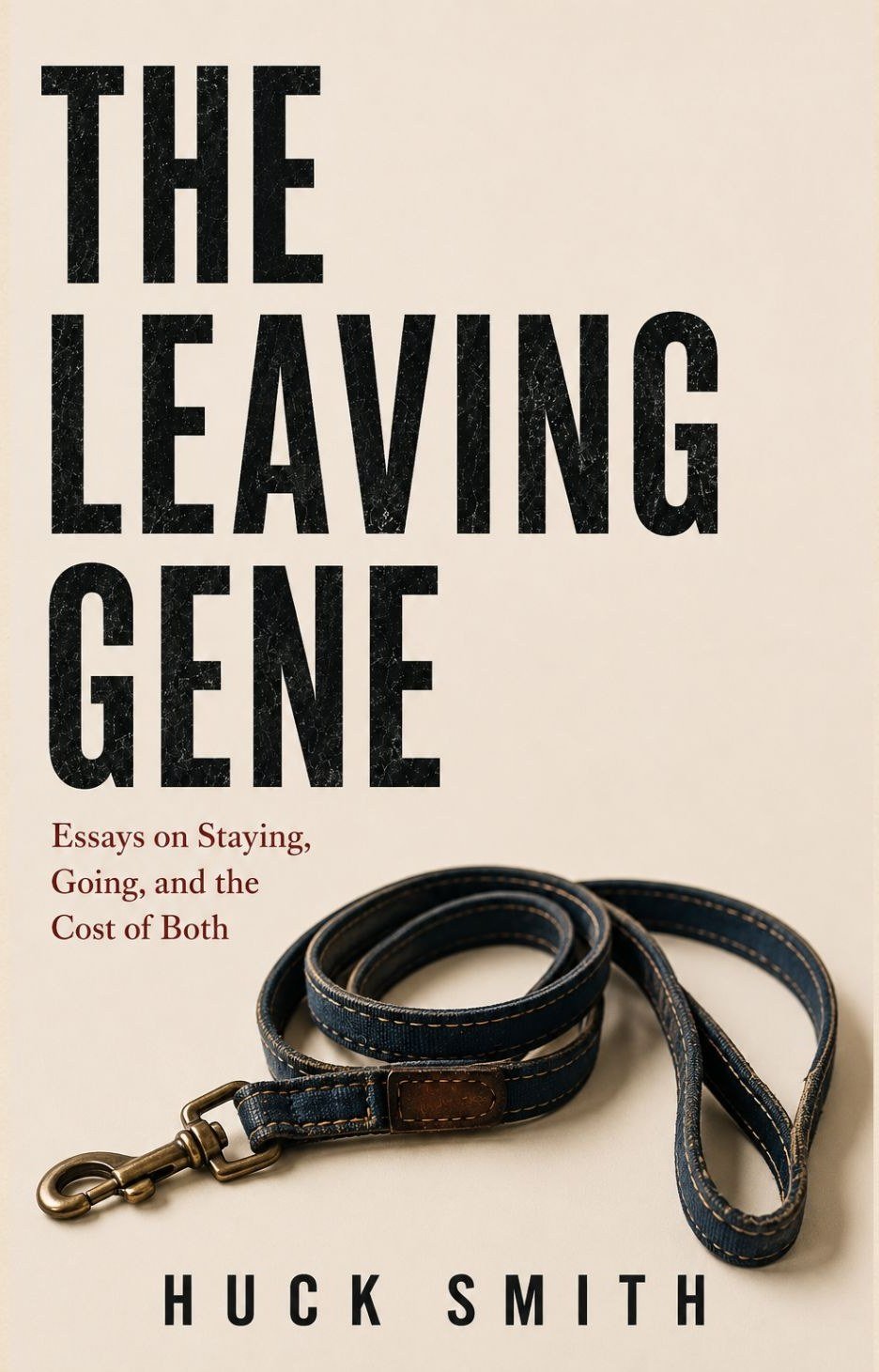
The Leaving Gene: Essays on Staying, Going, and the Cost of Both by Huck Smith comes out October 27, 2026 from Quick Draw Press. Connect with the author at huckysmith.com and on social media at @huckysmith. Photographs by Marlo, courtesy of the author.
If you or someone you know is struggling or in crisis, help is available. In the United States, call or text 988 to reach the 988 Suicide and Crisis Lifeline.
Author

About the author
Marie Juliane DAVID
Marie Juliane David is a multilingual journalist, poet and novelist, and the founder and Director of Publications of <em>CreARTivity Magazine</em>, which she launched on 10 January 2026 and has published daily since in English, French, Spanish and Haitian Creole. She has 140 published articles to her name in Haitian media, including the daily <em><a href="https://lenouvelliste.com/">Le Nouvelliste</a></em>, the newsletter of the <em><a href="https://rhjs.ht/">Réseau Haïtien des Journalistes de la Santé</a></em>, and <em><a href="https://www.odelpa.org/">ODELPA</a></em>, covering cultural life and the arts alongside public health, health literacy and social advocacy. She is the author of four books, three collections of poetry and a novel, and won the Prix Public Portez Haut les Couleurs in 2021. She writes in all four of CreARTivity's languages and edits all four editions herself. More of her work: <a href="https://mariejulianedavid.com/">mariejulianedavid.com</a>
Leave a comment
Your email will not be published. Comments are moderated before they appear.