CreARTivity
Magazine
Claude Bernard Sérant: A Writer-Journalist in the Service of Culture
In a country where memory grows fragile under the weight of successive crises, some men choose to hold the pen the way one holds a lamp. Claude Bernard Sérant is one of them. A journalist, essayist, and transmitter of knowledge, he has made writing not only a profession, but a mission: to serve culture, to pass it on, and to defend it.

In this article
Machine translation into other languages is available on the original page.
In a country where memory grows fragile under the weight of successive crises, some men choose to hold the pen the way one holds a lamp. Claude Bernard Sérant is one of them. A journalist, essayist, and transmitter of knowledge, he has made writing not only a profession, but a mission: to serve culture, to pass it on, and to defend it.
For him, writing is not a simple intellectual exercise. It is “matter, world, inner territory.” He adds, “One enters it as one explores an unknown land, in search of its contours, its silences, its flashes. To write is to seek the right words and to feel one’s breath vibrate within their flesh.”
Claude Bernard was born into writing in Carrefour-Feuilles, a neighborhood clinging to the slopes of Morne l’Hôpital, south of Port-au-Prince. “Even under the dictatorship, this place vibrated with an intense cultural fire: painting, theater, dance, music, and poetry,” he recalls. “Everyone carried their own ember,” he adds, evoking a time when culture flowed like vital energy.
Inspired by friends and an older brother who were already writing, Claude Bernard chose words. “Example is contagious. So I was contaminated,” he says with a smile. Very early on, he founded his own school periodical, Classe Magazine, printed in one thousand copies. “We wanted to exist through our ideas,” he explains.

Even before that initiative, he was publishing in Port-au-Prince’s renowned daily newspapers, Le Nouvelliste and Le Matin. He also wrote for various bulletins and school magazines, already taking on editorial responsibilities. “I did not yet know that this hobby would become my life,” he admits.
This youthful effervescence extended to radio: cultural programs on Radio Cacique and recreational shows such as Hebdodétente. In the 1980s, Claude Bernard hosted major events from Rex Theater to the French Institute, in a Haiti alive with cultural vibrancy. “It was a time when culture filled the streets, the halls, the minds,” he says.
Between Numbers and Letters: A Formative Detour
Interestingly, journalism was not his initial calling. The young Claude Bernard chose accounting. “For me, journalism was first a hobby,” he states. He worked for ten years in commerce and studied Management, Computer Science, and later Law. “I learned the rigor of numbers before returning to the freedom of words,” he emphasizes.
At the same time, he immersed himself deeply in books. Encouraged by his employer, he discovered major authors in economics, philosophy, anthropology, and science. “Books occupied a central place in my life,” he recounts. He read Hayek, Lévi-Strauss, Chomsky, and Popper, and devoured hundreds of novels, from García Márquez to Camus. “I truly lived in books,” he says. “Novels taught me to see the world differently.”
This intellectual foundation gave his writing a rare depth, nourished by economics, politics, literature, and science. “When you accumulate such knowledge, you pass it on,” he says simply.

Claude Bernard learned journalism by doing. “I learned it on the job,” he affirms. Seminars in Haiti and abroad, notably in the United States, France, Senegal, and Brazil, strengthened his expertise, particularly in health reporting. “Health and culture are two vast, almost infinite fields,” he explains.
He first worked at the state newspaper L’Union, writing daily as a general reporter. “That’s where I began writing every single day,” he remembers. After the paper closed, Le Nouvelliste called him. He officially joined in 2004. “I never imagined I would spend more than two decades there,” he confides. Next May, he will celebrate twenty-two years with the daily newspaper founded more than 126 years ago.
Today, Claude Bernard heads the Culture section of Le Nouvelliste. His commitment goes beyond the newsroom. Secretary General and founding member of the Haitian Health Journalists Network, he is nicknamed “coach.” “Wherever I go, I pass things on,” he asserts. He leads writing workshops, teaches multimedia communication, and introduces his students to journalistic writing and photography. For him, photography is also writing: “a writing of light.” “An image that illustrates an article is also a text to be read,” he adds.
A Literary Work Rooted in Memory
In 2005, Claude Bernard published his first book, Rien que pour un instant (“Just for a Moment”). “The idea matured in Paris,” he explains. Other works followed: La soupe au giraumon de grann Adé, La guerre des cerfs-volants, Galère en autobus (Volumes 1 and 2), and Traces au quotidien. He also co-authored works such as On n’assassine pas un poète and Carnaval des Cayes, pari gagné.
Speaking of La soupe au giraumon de grann Adé, he says, “This book is a tribute to our culinary memory and our identity.” The work was used as a reference by the Ministry of Culture during the submission of Haiti’s giraumon soup to UNESCO for recognition. “Seeing my work cited in that context was an honor,” he confides.
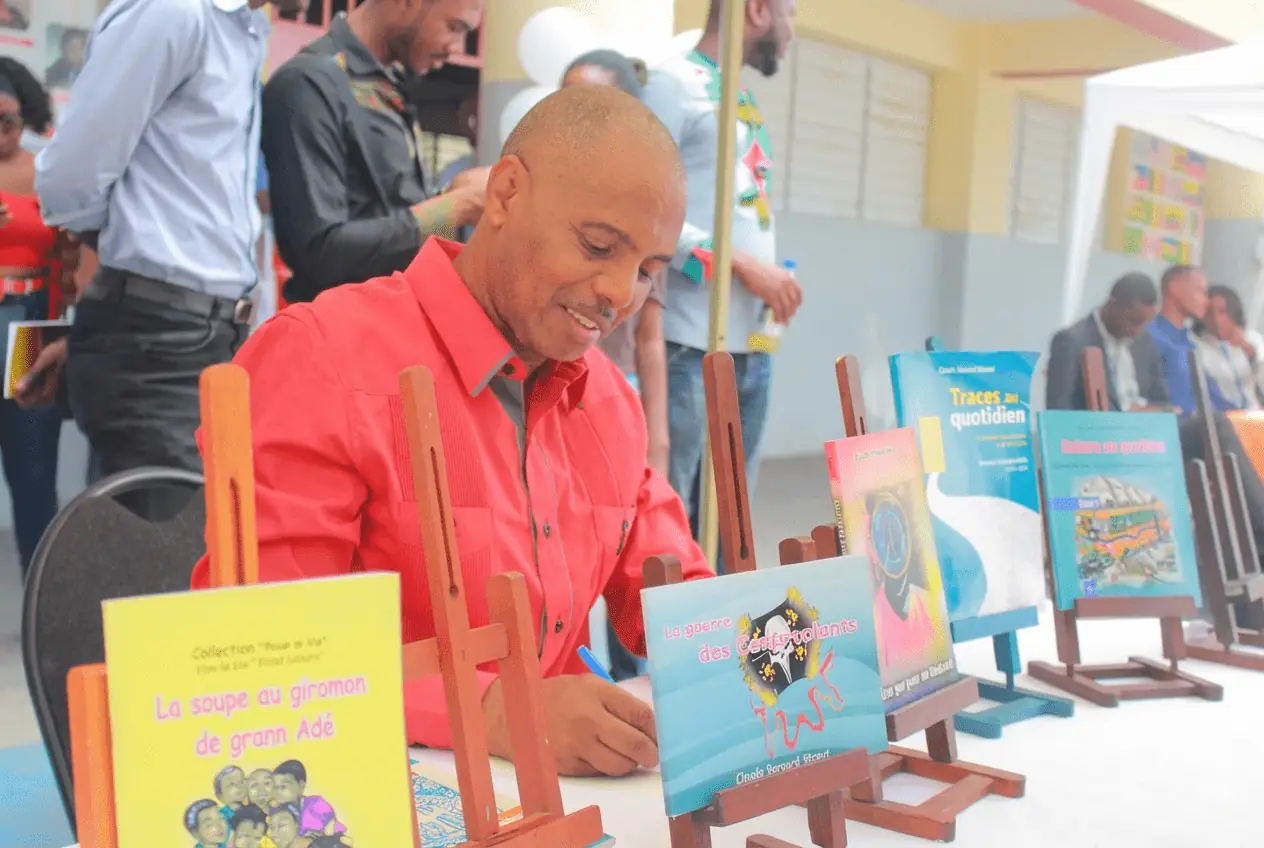
A multidisciplinary journalist, Claude Bernard explores literature, painting, theater, dance, and cinema. “Each discipline opens up a world,” he says. This path earned him admission into the International Association of Art Critics, Caribbean section. “It is recognition of the work accomplished,” he notes modestly.
Claude Bernard Sérant’s journey tells more than a career story. It tells of fidelity to a neighborhood, a generation, a culture. “I remember a time when living together was not a slogan but a practice,” he reflects. “Then violence scattered the voices.”
Through his articles, books, and workshops, he continues to build bridges between memory and modernity. “What remains, if not words?” he asks. “Perhaps that is what writing ultimately is: saving what can be saved.”
In a world where everything fades quickly, Claude Bernard Sérant reminds us that words can endure.
Author

About the author
Marie Juliane DAVID
Marie Juliane David is a multilingual journalist, poet and novelist, and the founder and Director of Publications of <em>CreARTivity Magazine</em>, which she launched in January 2026 and publishes daily in English, French, Spanish and Haitian. To learn more about her and her work, visit her <a href="https://mariejulianedavid.com/" target="_blank" rel="noopener">portfolio</a>.
Leave a comment
Your email will not be published. Comments are moderated before they appear.